How to Look 3 Inches Taller: The Complete Playbook for Men
By Height Simulator Editorial Team ·
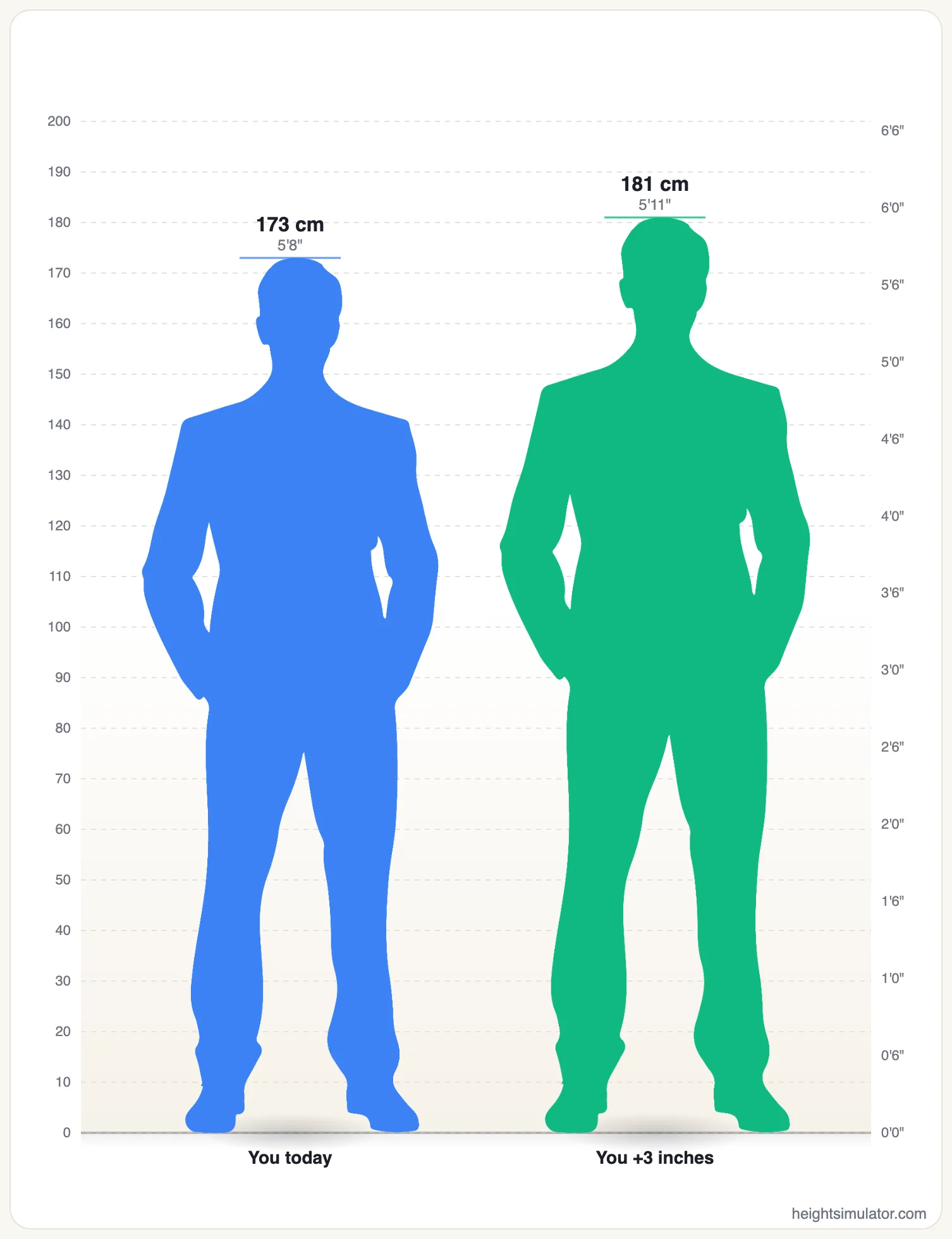
Three inches is the gap between 5'8" and 5'11", and in most rooms it is the gap between "average" and "tall." You cannot lengthen your bones as an adult, but the height people assign you is not read off a tape measure. It is an estimate their eyes make in a second or two, and estimates can be moved. Some of the levers below add real, measurable centimeters. Others change how your height is judged. Stack them and the combined effect comfortably reaches the three-inch mark, without a single element that looks like a trick. Before you read on, it helps to see what you are playing for: open the height comparison tool, add yourself at your current height, then add a second figure three inches taller, and keep that picture in mind through the rest of this guide.
Why Your Eyes Can Be Moved Three Inches
Nobody measures you when you walk into a room. They estimate, and estimation relies on shortcuts. Three of those shortcuts matter here.
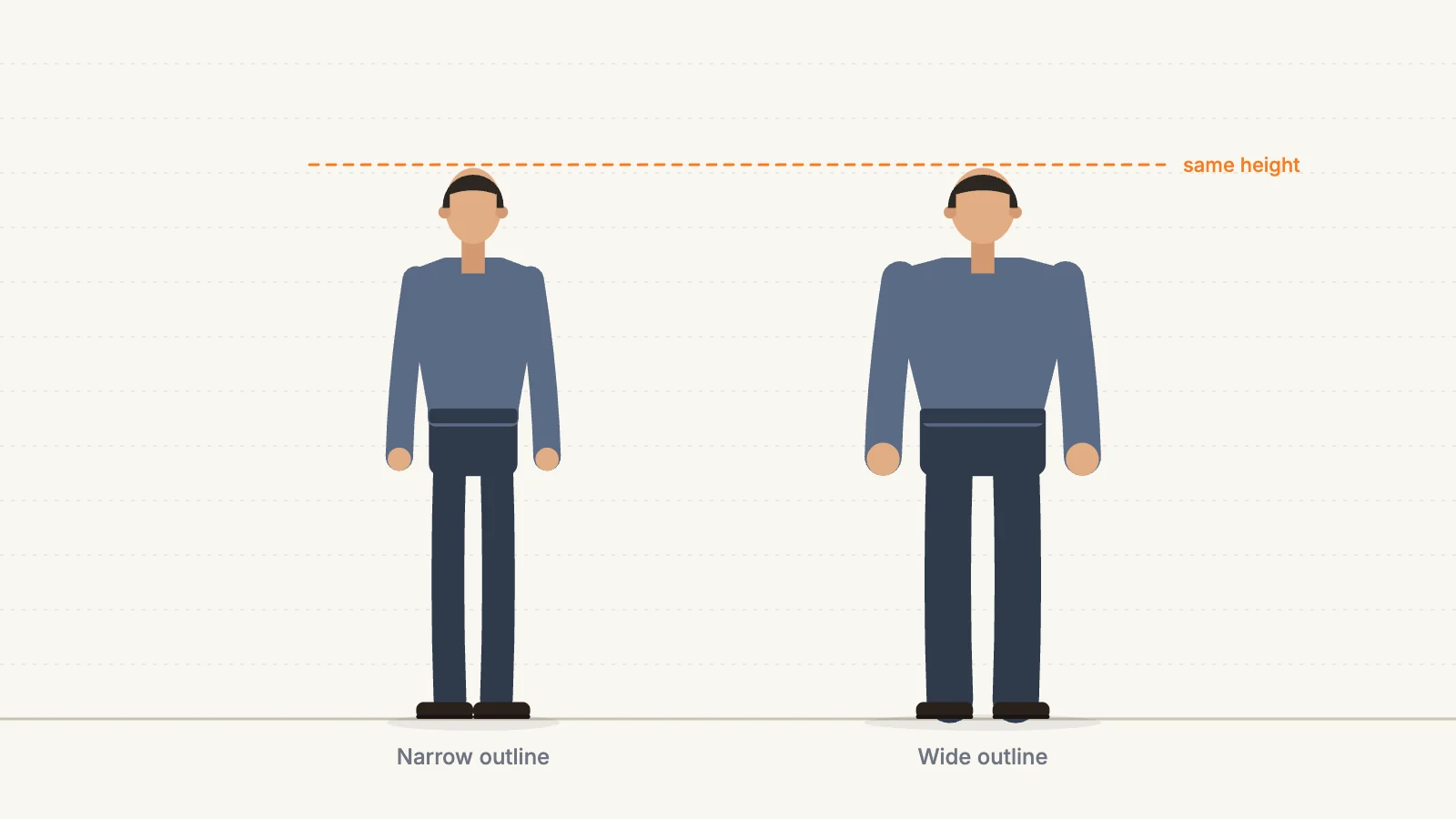
The height-to-width ratio. The eye judges tallness partly as a ratio, not an absolute number. A narrow shape of a given height reads taller than a wide shape of exactly the same height, which is the same reason a tall, slim glass looks like it holds more than a short, wide tumbler with an identical pour. Anything that slims your outline effectively lends inches to it.
Unbroken vertical lines. The visual system tends to group connected elements into one object and measure them as a whole, a principle perception researchers call continuity. If your outfit forms one continuous column from shoe to collar, the eye measures the full length in one sweep. If a strong contrast line cuts you in half at the waist, the eye measures two short blocks instead of one long one.
Reference points. Height is judged against whatever is nearby: door frames, furniture, and above all other people. You cannot control every reference, but you can control your own top line, which is set by posture and hair, and you can avoid habits that surrender inches next to taller people, which is where the celebrity examples later in this guide earn their keep.
Every recommendation that follows works on one of these three shortcuts, and that is also the test you can apply to any styling advice you read elsewhere: if it does not slim the outline, extend a vertical line, or raise your top line, it probably does not make you look taller.
Posture: The Only Free Inch, and It Is Real
Start with the lever that changes the actual measurement. Your spine is not a rigid rod. Between the vertebrae sit discs filled with fluid, and they compress under the load of standing and sitting through the day, then rehydrate and expand while you sleep lying down. This is why you are measurably taller in the morning than at night: one stadiometer study of spinal loading recorded a mean daily height variation of 14.4 millimeters, a little over half an inch, between morning and evening measurements. If you want to see your own number, measure yourself right after waking and again before bed, then put both figures into the height difference calculator to see the gap drawn to scale.
Slouching costs you more than disc compression does. A forward head, rounded shoulders, and a collapsed mid-back each shave visible height off your top line, and together the loss commonly exceeds an inch. The mechanics are simple: your measured height runs from the floor to the crown of your head, and every joint that folds forward lowers the crown. Standing fully upright restores length your skeleton already has.
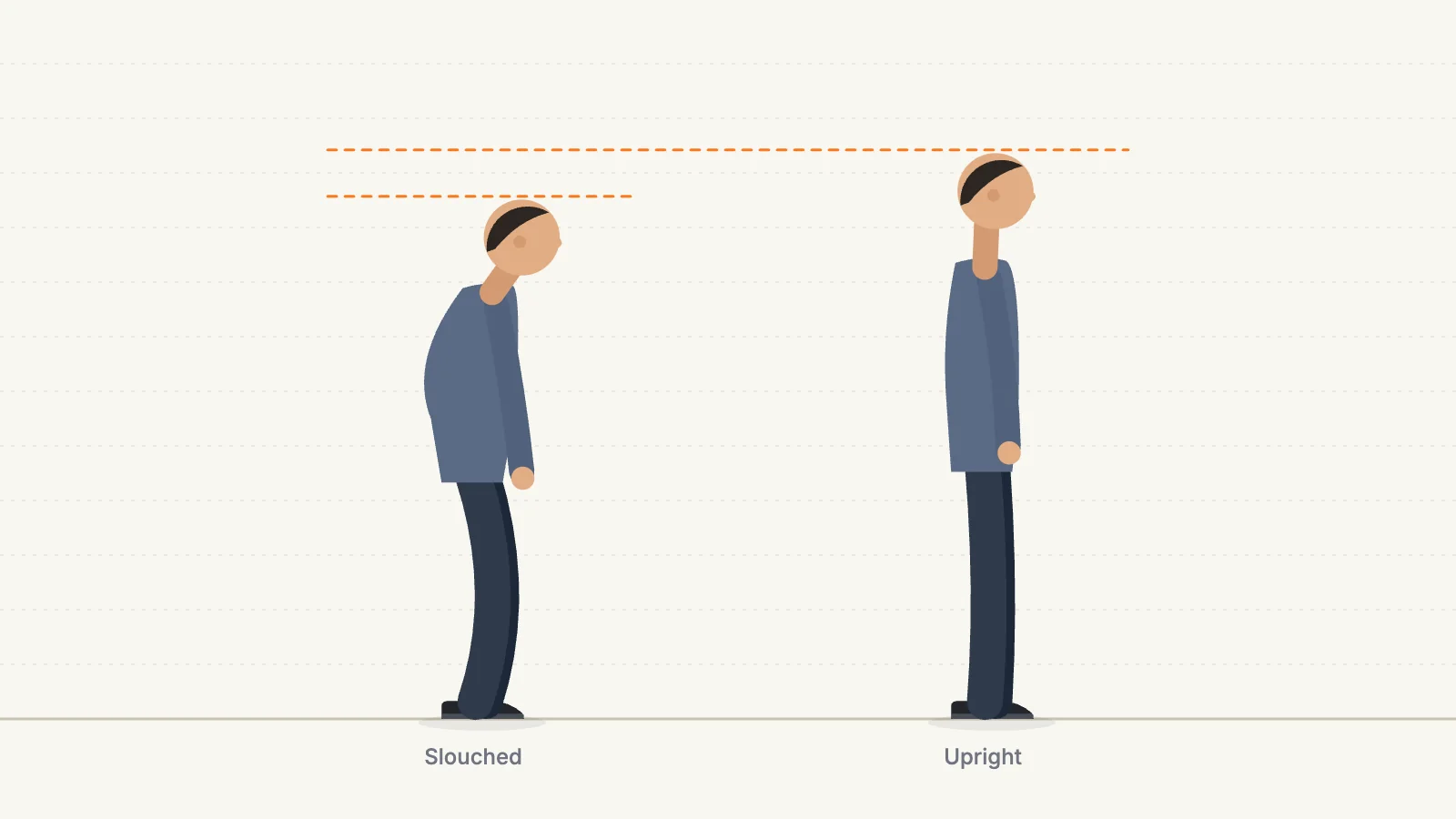
The problem is that "stand up straight" is a cue, not a fix. Upright posture has to become your resting default, and that is a strength and mobility project rather than a willpower project:
- Strengthen the muscles that hold you tall. Rows, reverse flys, and face pulls build the upper-back muscles that keep shoulders back without conscious effort, and chin tucks retrain a head that has drifted forward from hours spent looking down at screens.
- Stretch what desk work shortens. Tight hip flexors tilt the pelvis and chest muscles pull the shoulders forward; a daily couch stretch and doorway chest stretch counter both.
- Decompress the spine. Dead hangs from a pull-up bar and a few minutes lying flat take load off the discs, the same unloading that restores height overnight.
- Rebuild the stance cue. Feet under hips, ribs stacked over pelvis, chin level with the floor, and the crown of the head reaching up, as if measured against a wall.
Posture also pays twice. Beyond the restored centimeters, an upright carriage is itself read as a tall person's bearing, so the same height carried well is routinely guessed higher than the same height carried slumped.
Fit: A Slim Outline Reads as a Tall Outline
Because tallness is judged partly as a height-to-width ratio, excess fabric works directly against you. A billowing shirt or wide, pooling trousers add visual width at the exact moment you want the eye to read length, and the wider silhouette is judged shorter even though your height has not changed by a millimeter.
The target is tailored, not tight. Shoulder seams should sit at the end of the shoulder bone, sleeves and shirt body should follow the arm and torso with a small allowance of ease, and trousers should taper gently from thigh to ankle so the leg reads as one clean line. Clothing that strains at the buttons introduces its own horizontal stress lines, which are as counterproductive as bagginess. If you buy off the rack, a basic alteration visit to take in a shirt's sides and hem trousers to the correct length is the cheapest height upgrade in this entire guide.
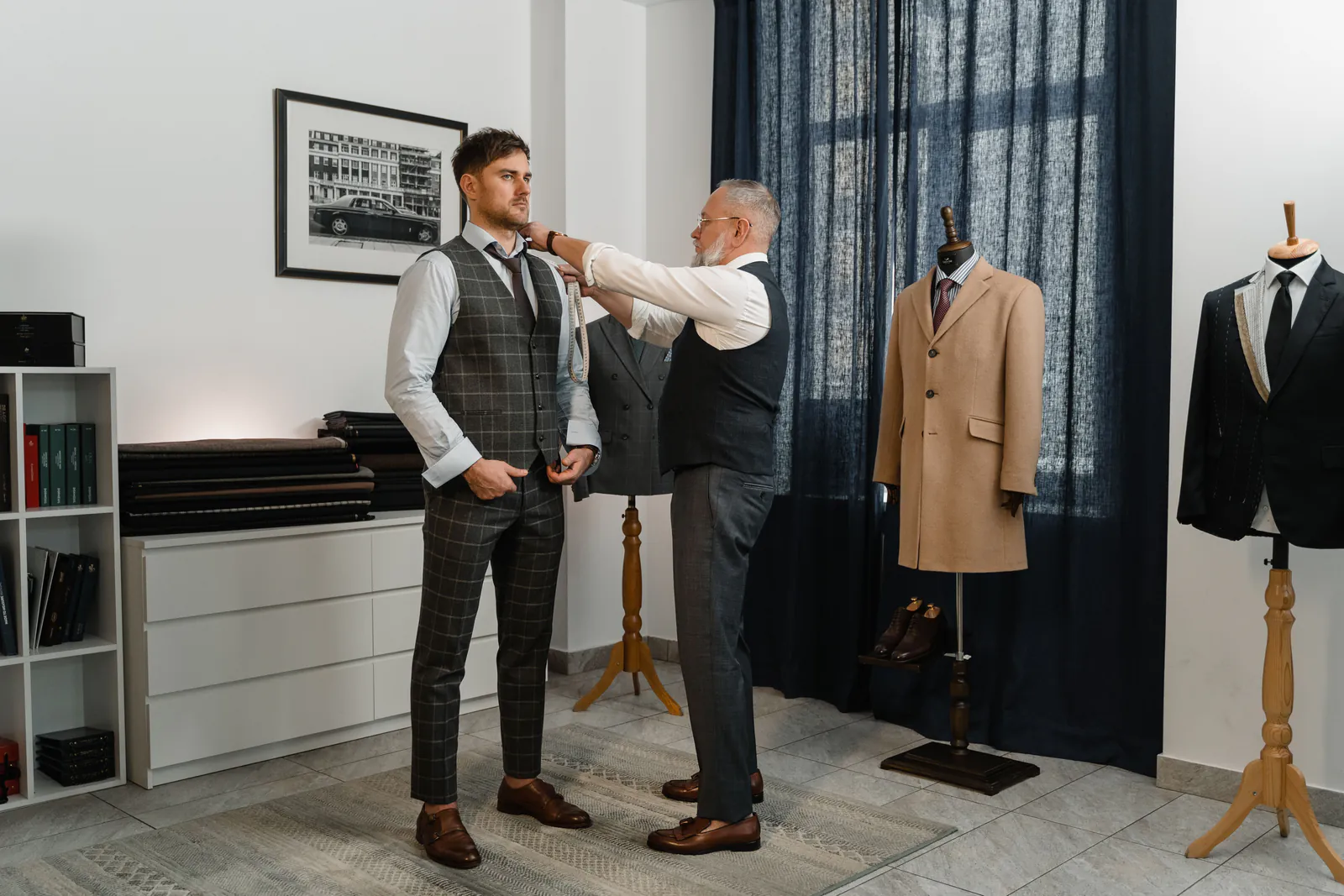
One fit rule deserves special mention because so many men get it backwards: oversized clothing does not hide a smaller frame, it shrinks it. Extra fabric moves the outline outward and the perceived height downward at the same time.
Body composition works on the same ratio. Carrying less fat around the waist narrows the outline at exactly the point where width is most visible, so a leaner man tends to read taller at the same height. The effect on the spine itself is smaller than often claimed: in a study of 30 severely obese adults one year after weight-loss surgery, one lower-back disc measured about 2 millimeters taller on scans (Lidar and colleagues, Spine), but standing height was not measured, and there is no good evidence that ordinary weight loss adds inches. Treat leanness as a lever on your outline, not on the tape measure.
Color: Build One Column, Avoid the Horizontal Cut
Color is where the continuity principle does its work. Dress head to toe in one color, or in close shades of the same family (navy over indigo denim, charcoal over black, cream over stone), and your outfit becomes a single vertical column that the eye measures in one pass. Put a white shirt over black trousers with a heavy contrast belt and you have drawn a bright horizontal line across your midpoint, inviting the eye to measure a short top block and a short bottom block instead of one long figure.
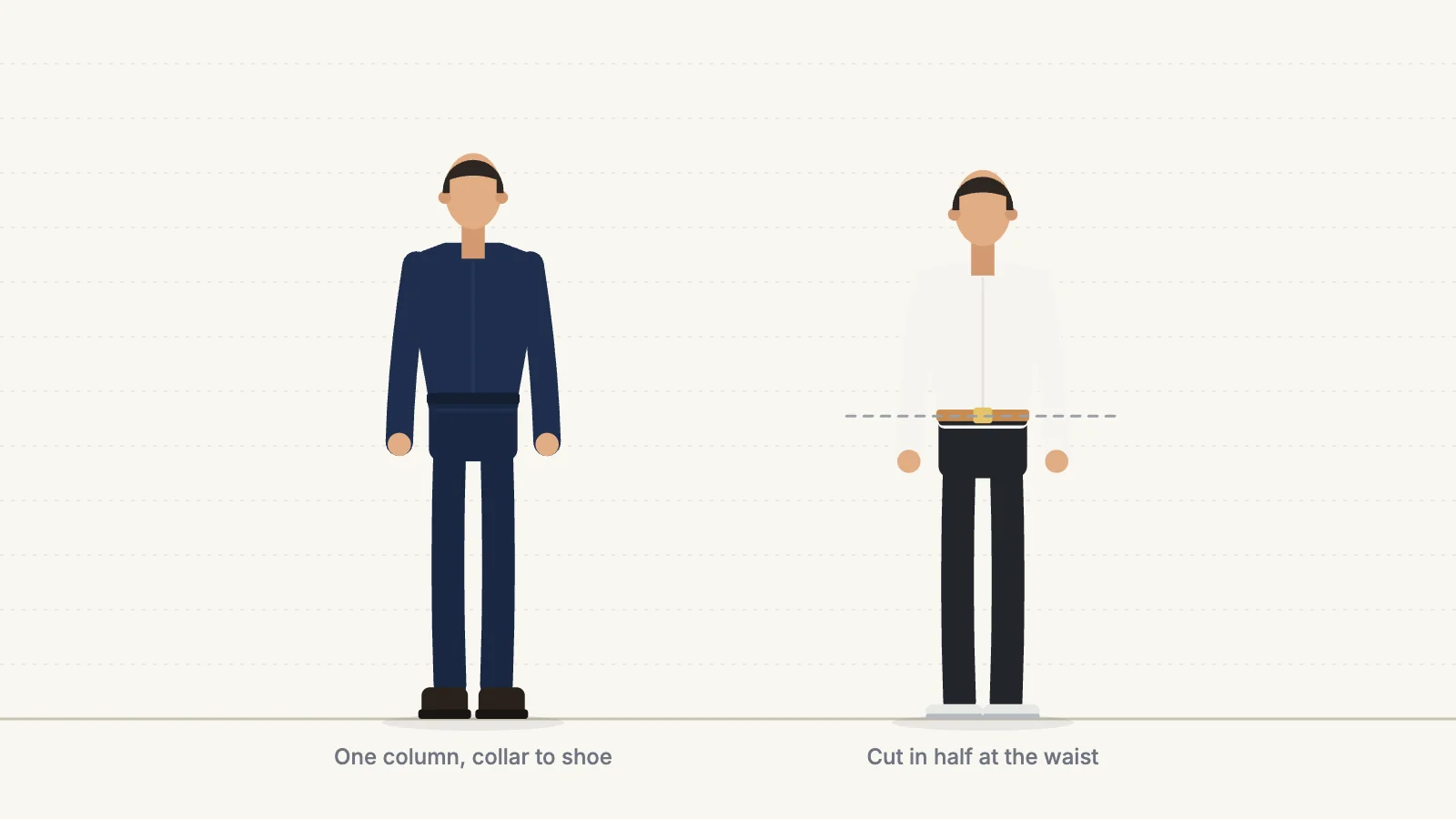
That gives you three practical rules:
- Keep top and bottom low-contrast. They do not need to match exactly; they need to flow. Tonal outfits in dark or mid shades also slim the outline slightly, which compounds the effect.
- Recruit your shoes into the column. Footwear close to your trouser color extends the leg line into the floor, while a sharply contrasting shoe ends the leg at the ankle.
- Mute the belt. A belt that matches the trousers disappears into the column; a wide belt with a bright buckle is a horizontal cut you paid for.
What about stripes? The folk rule says vertical stripes lengthen, but the research is less obliging. The classic Helmholtz illusion shows a square filled with horizontal lines appearing taller and narrower than the same square filled with vertical lines, and a study in the journal i-Perception (Thompson and Mikellidou) found that a block of vertical stripes had to be made about 7 percent taller before it looked as tall as the horizontally striped version. Later work on photographs of real bodies found the effect shifts with the wearer's build, so stripes are not a dependable tool in either direction. The safer play is structural vertical lines rather than printed ones: a button placket, sharp trouser creases, lapels, an open jacket or cardigan worn over a tonal base, and a zip or scarf hanging straight. These create genuine top-to-bottom paths for the eye without betting on a contested illusion.
Proportion: Move the Waist Up, Lengthen the Legs
People do not just read your total height; they read where your legs appear to begin, and longer-looking legs are strongly associated with tallness. In a study published in Royal Society Open Science (Versluys, Foley, and Skylark), women rating computer-generated male figures of identical height found those with a leg-to-body ratio slightly above the population average the most attractive, with short-legged figures rated lowest. You cannot change your femurs, but you can change where your legs appear to start, because the eye takes the visual waistline, the point where trousers meet top, as the dividing line.
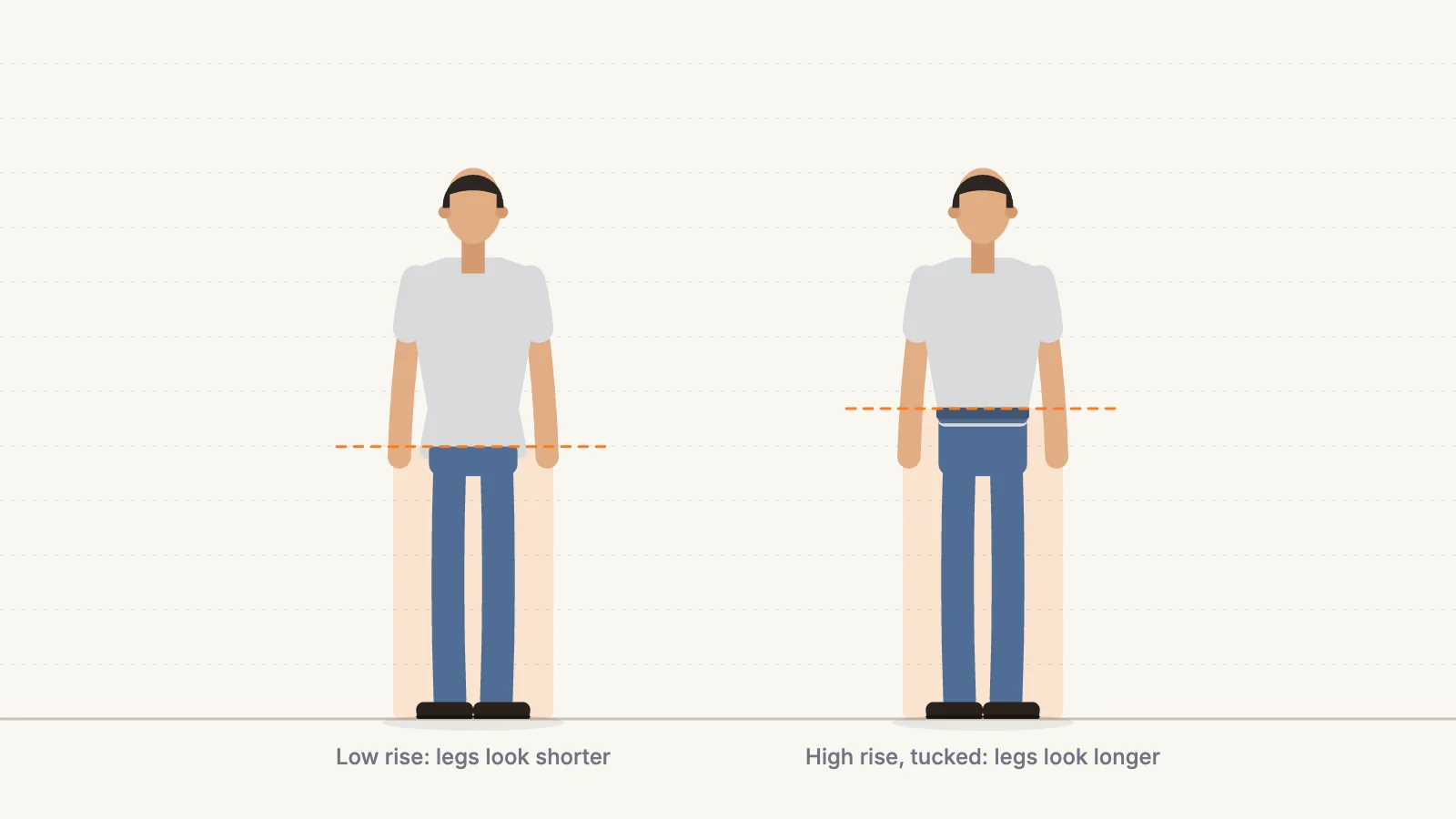
Every one of these moves shifts that dividing line upward:
- Wear mid-to-high-rise trousers. A rise that sits at or just below the navel places the visual waist near your true waist; low-rise trousers hand several inches of your leg line to your torso.
- Tuck, or cut the hem short. A tucked shirt marks the waist crisply. If you wear shirts and tees untucked, the hem should end around mid-fly; a hem that reaches the thighs buries the waistline entirely.
- End jackets at the hip. A suit jacket, bomber, or overshirt that finishes near the hip crease keeps the leg line long; one that reaches toward mid-thigh swallows it.
- Raise the button. On a suit jacket or blazer, a top button that fastens at or just above the navel sets the visual waist high, the same effect a higher trouser rise has; a low button stance drags the waist, and the leg line, down with it.
- Carry the trouser into the shoe. Combined with the matching-shoe rule above, a raised waist and an unbroken trouser-to-shoe line can make the leg read several inches longer than the same leg in low-rise trousers and contrast sneakers.
This is the least-known lever in this guide and one of the strongest. Two men of identical height, one in low-rise jeans and a long untucked tee, one in higher-rise trousers with a tucked shirt, do not read as the same height, and the difference is entirely about where the eye believes the legs begin.
The Details: Necklines, Hems, and Scale
A handful of smaller choices either support the column you have built or quietly undermine it.
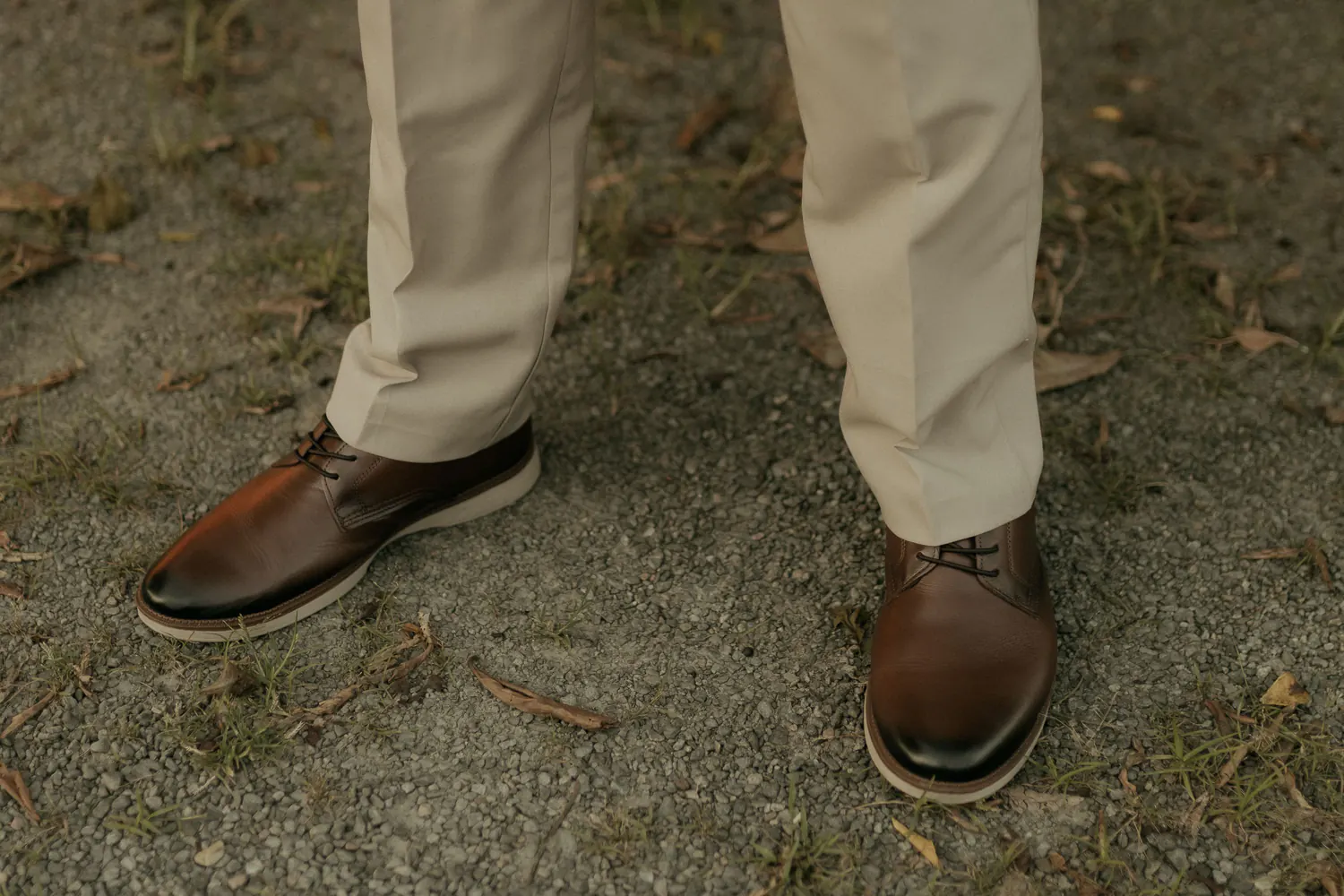
- Open the neckline. A V-neck, henley, or an open collar extends the vertical line of the neck and chest; a tight crew neck or a thick scarf wound horizontally shortens it.
- Lose the trouser break. Fabric pooling over the shoe adds horizontal folds at the bottom of your line. Hem trousers so they sit with a slight break or none, just touching the shoe. Skip turn-ups (cuffs) for the same reason, since the folded band draws a horizontal line across the ankle.
- Scale accessories down. Size is judged relatively, so the objects on your body act as rulers for your body. Slim lapels, a tie that ends at the waistband, a modest watch face, and smaller-scale prints all make the frame wearing them read larger; oversized bags, chunky oversized watches, and huge logos do the opposite.
- Keep outerwear above the knee. Long coats can work when they are slim and worn as one tonal column, but the safest lengths end at the hip or upper thigh.
- Clear the horizontal clutter. Thigh-level cargo pockets, wide contrast cuffs, and heavily distressed horizontal rips on jeans all add crosswise lines exactly where you want flow.
Footwear: Real Inches, Handled With Restraint
Shoes deserve their own section because they are the one garment that changes the number as well as the impression. They also deserve restraint, because they are the element most likely to announce itself when overdone, and because a strategy that is nothing but tall shoes collapses the moment they come off. Treat footwear as one planned inch of your stack, perhaps a little more, and let the rest of the guide do the remaining work.
The honest arithmetic, measured against standing barefoot, runs roughly as follows. Minimal flat sneakers typically add around half an inch to three quarters of an inch. Standard dress shoes such as derbies and oxfords generally sit near one inch. Boots, including Chelsea, chukka, and heeled western styles, commonly add between one and one and a half inches, and thick-soled sneakers now reach similar territory while reading as ordinary streetwear. None of these registers as a height device, because they are simply shoes.
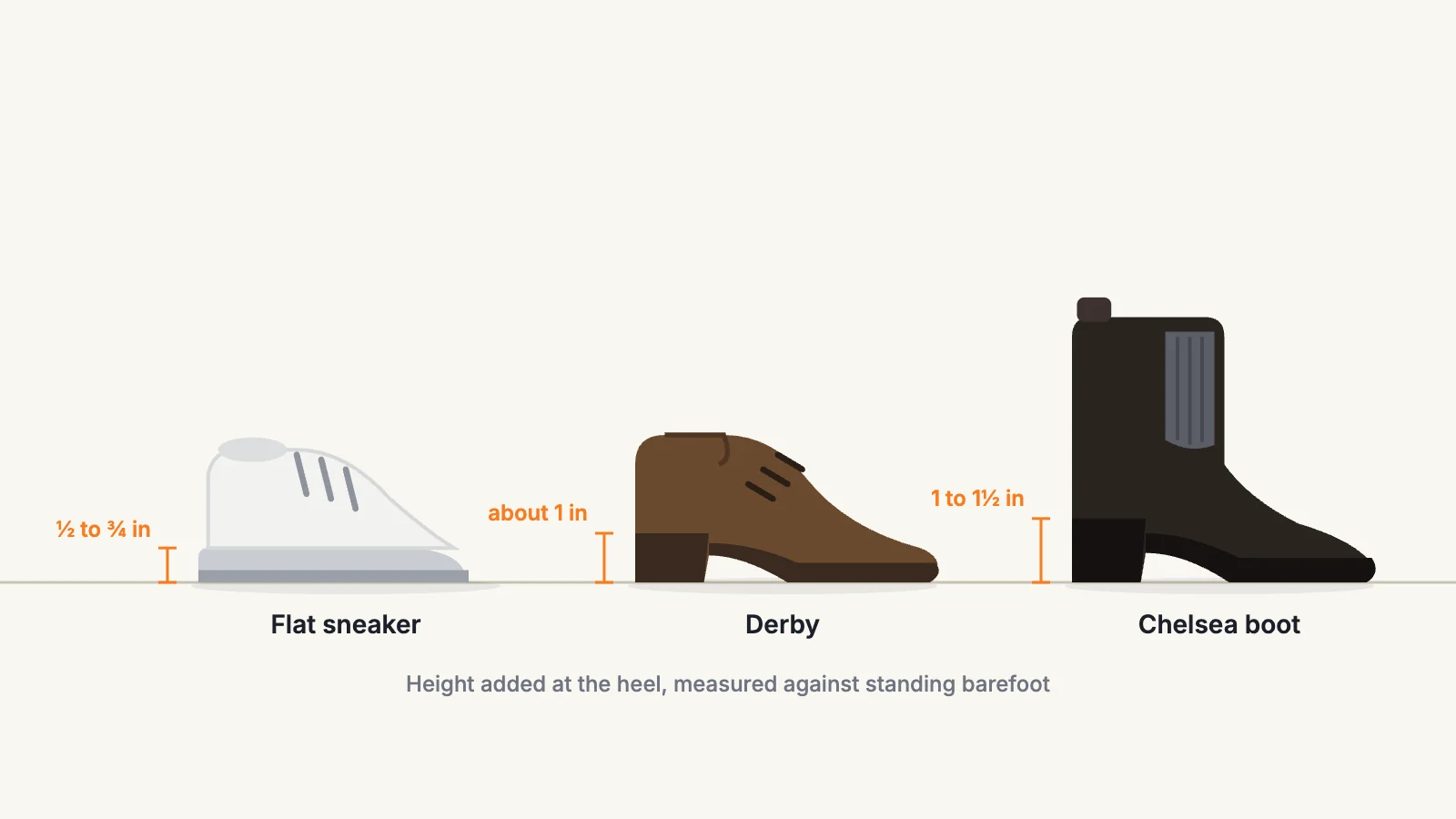
Discreet in-shoe lifts can add roughly half an inch to an inch inside boots or high-top sneakers, where the raised ankle hides the altered footbed. Push past that and the disguise fails in predictable ways: the heel of your foot rides visibly high, trouser hems that fit before now float above the shoe, and your gait tips forward. Purpose-built elevator shoes promise more, and some men wear them happily, but go in with clear eyes: the taller the hidden stack, the more the proportions of the shoe itself (a short visible vamp on a tall body) give the game away to anyone who looks.
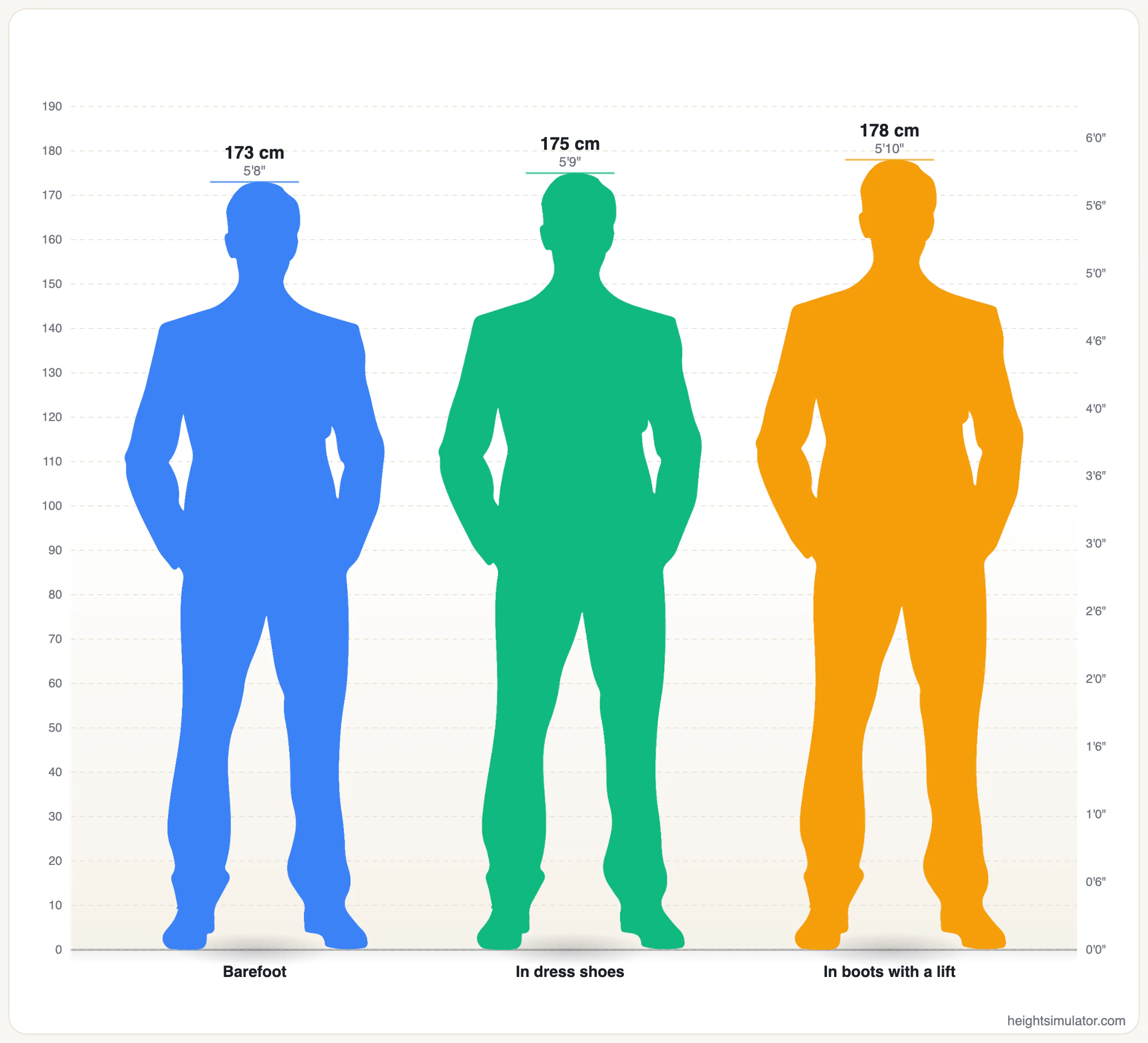
Two closing rules keep footwear working for you rather than against you. First, pick a baseline and keep it consistent, so that colleagues and friends meet the same height every day; a man who fluctuates two inches between Monday and Saturday invites exactly the scrutiny he was avoiding. Second, remember the column: a sleek, trouser-matched boot adds its inches and extends the leg line, which is two levers in one purchase. Shape matters as much as height: a slimmer, gently tapered toe carries the leg line forward, while a wide, bulky shoe adds visual weight at the very bottom of the frame.
Hair: The Top Line Counts
Your silhouette does not stop at your scalp. The eye takes the outline of the hair as the top of the figure, which is why hairstyle can add a genuine inch or more to your apparent top line. The formula is height on top, tightness at the sides. A quiff, pompadour, textured crop styled upward, or faux hawk raises the crown; short, tapered, or faded sides keep the head narrow, which both supports the added height and feeds the slim-outline ratio. The reverse combination, a flat top with wide, full sides, broadens the head and shortens the figure.

A light-hold matte product makes the lift last without the collapse that heavy wet-look products cause by evening. For men with thinning hair, a shorter crop with tight sides still preserves the narrow top line, which matters more than the absolute lift. Facial hair follows the same geometry: a beard trimmed tight at the cheeks and allowed slightly more length at the chin elongates the face, while full, wide cheek growth broadens it.
Hats work on the same top line. A hat with some height in the crown, such as a fedora or a trilby, extends your outline above the head, while a flat cap or a tight beanie adds little height and can widen the head instead. Keep the hat in proportion to your frame: an oversized brim adds width at the top and undoes the lift.
In Photos: Where You Stand Changes the Picture
A photograph flattens a scene into one image, and cameras follow a simple rule of perspective: the closer something is to the lens, the larger it appears. In pictures, that rule can settle a height difference as much as height does.
A few habits put it on your side. Stand a half step in front of a taller person rather than shoulder to shoulder, so you sit slightly closer to the camera. Leave a little space between you, since a gap removes the direct side-by-side reference the eye uses to compare. Ask whoever takes the picture to hold the camera around chest height rather than above their head; a lower angle tends to lengthen figures in the frame, while a high angle shortens them. On uneven ground, take the higher step or the curb side. And hold the posture from earlier in this guide, because a slouch reads even more clearly in a still image than in person.
The Celebrity Playbook: Shorter Men Who Stand Level With Taller Ones
Nowhere is this toolkit tested more brutally than on a red carpet, where shorter stars stand beside taller co-stars under studio flash, and the photos circulate forever. The men below are worth studying not because they hide their height, which is publicly listed and endlessly discussed, but because they manage the impression so well that the listed gap rarely matches the felt gap. The heights given are the figures widely listed in public height databases, treat them as close estimates rather than certified measurements. You can compare any of them, along with thousands of other famous people, in the celebrity heights directory.
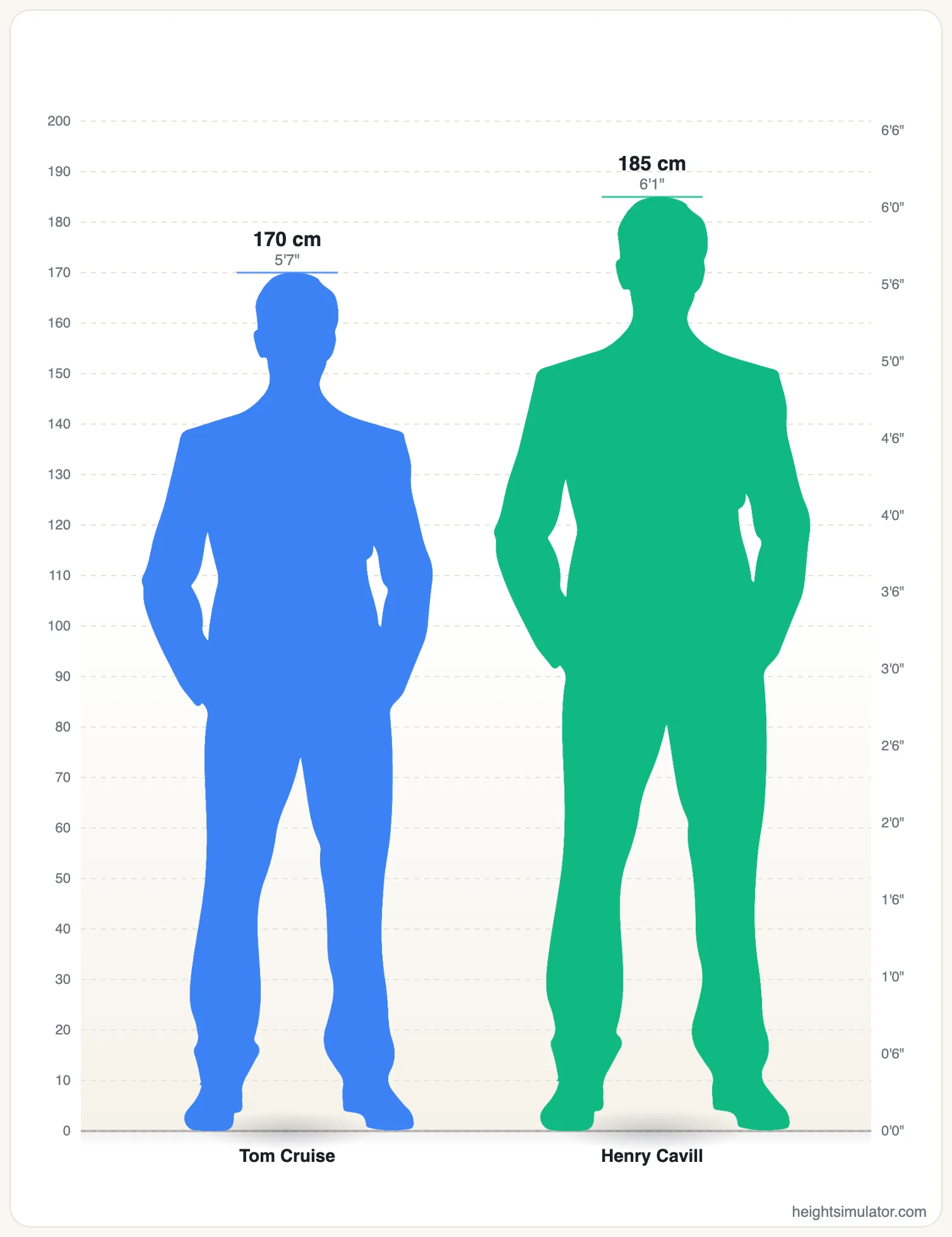
Tom Cruise beside Henry Cavill


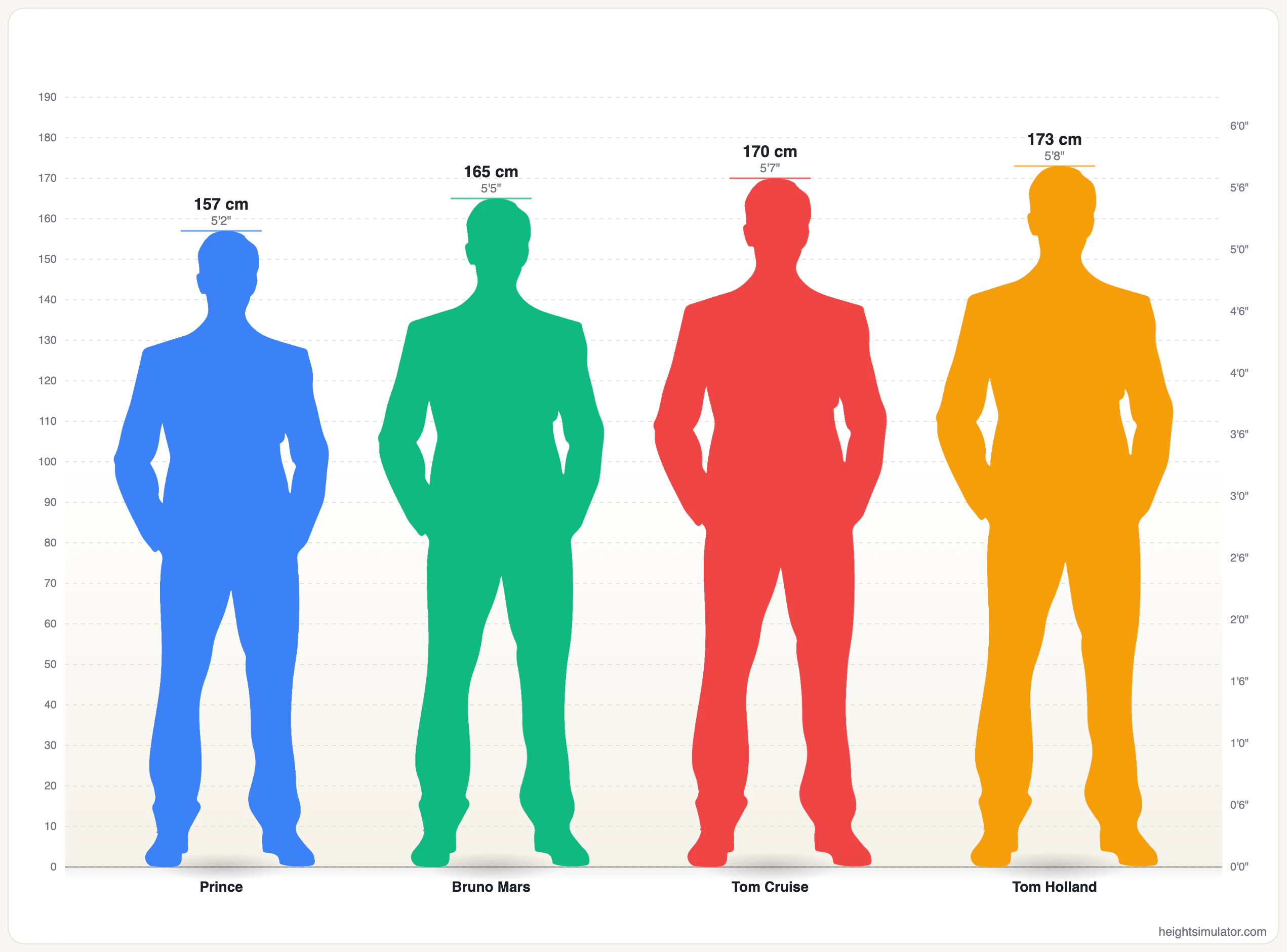
Cruise is listed at around 5'7" and spent an entire press tour photographed next to Cavill, listed at around 6'1". On paper that is a six-inch gap; in many of the photos it reads as far less. Watch what Cruise controls: a fully stacked, upright stance with a level chin, slim dark outfits worn as one column, substantially soled boots, and no posture of apology whatsoever. He positions himself as the center of the frame and stands like it. The lesson is not any single garment, it is that every lever in this guide is pulled at once, every time.
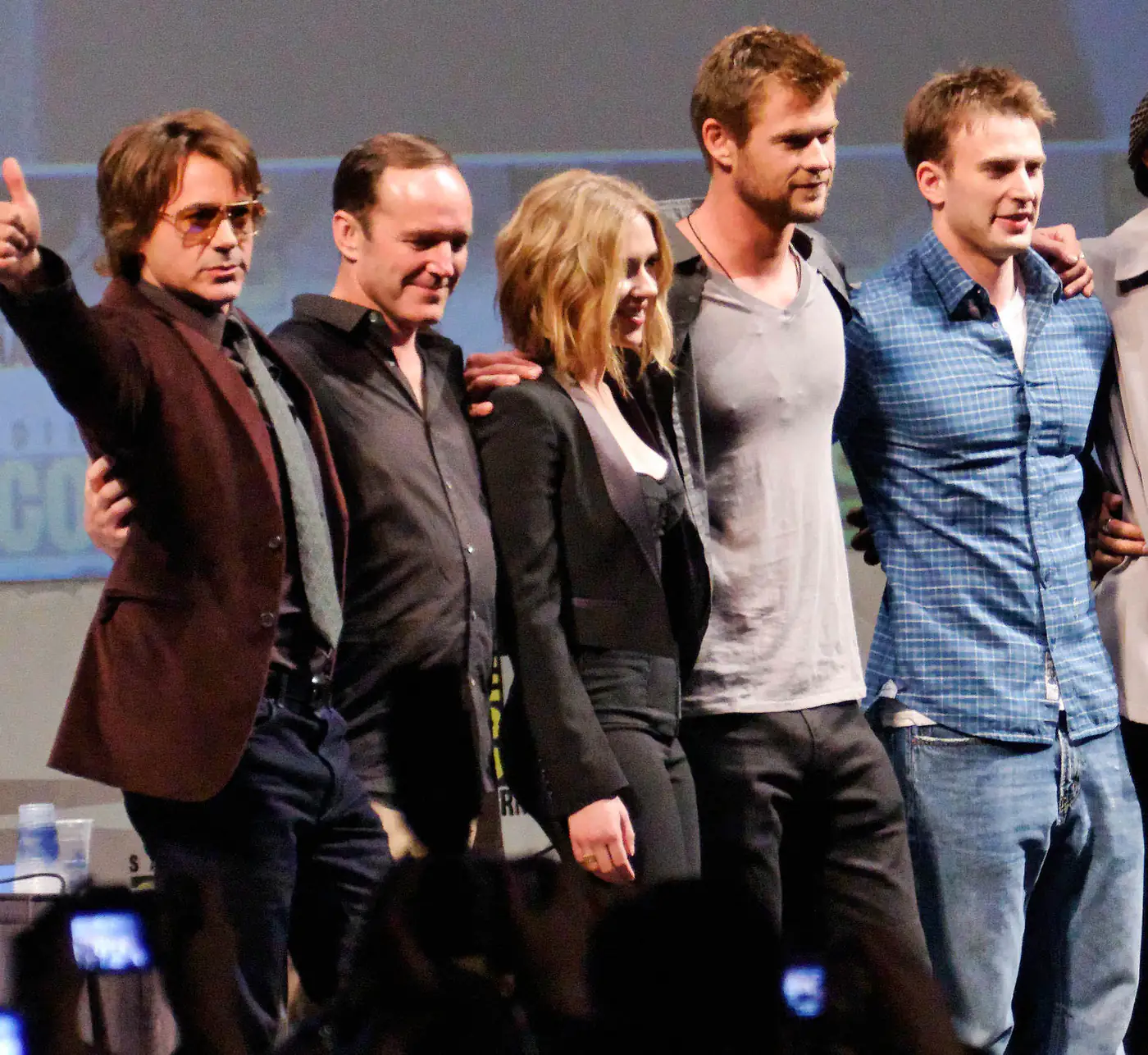
Robert Downey Jr. beside Chris Hemsworth
Downey is listed at around 5'9" and spent a decade of premieres alongside Hemsworth at around 6'3". His toolkit is tailoring-led: three-piece suits whose waistcoat panel runs an unbroken vertical line from collar to trouser, slim lapels, trousers with no break, and visibly built-up footwear that he has worn openly and joked about rather than concealed. That last point is its own lesson: delivered with confidence, an inch of shoe reads as style, not insecurity.

Tom Holland beside Zendaya
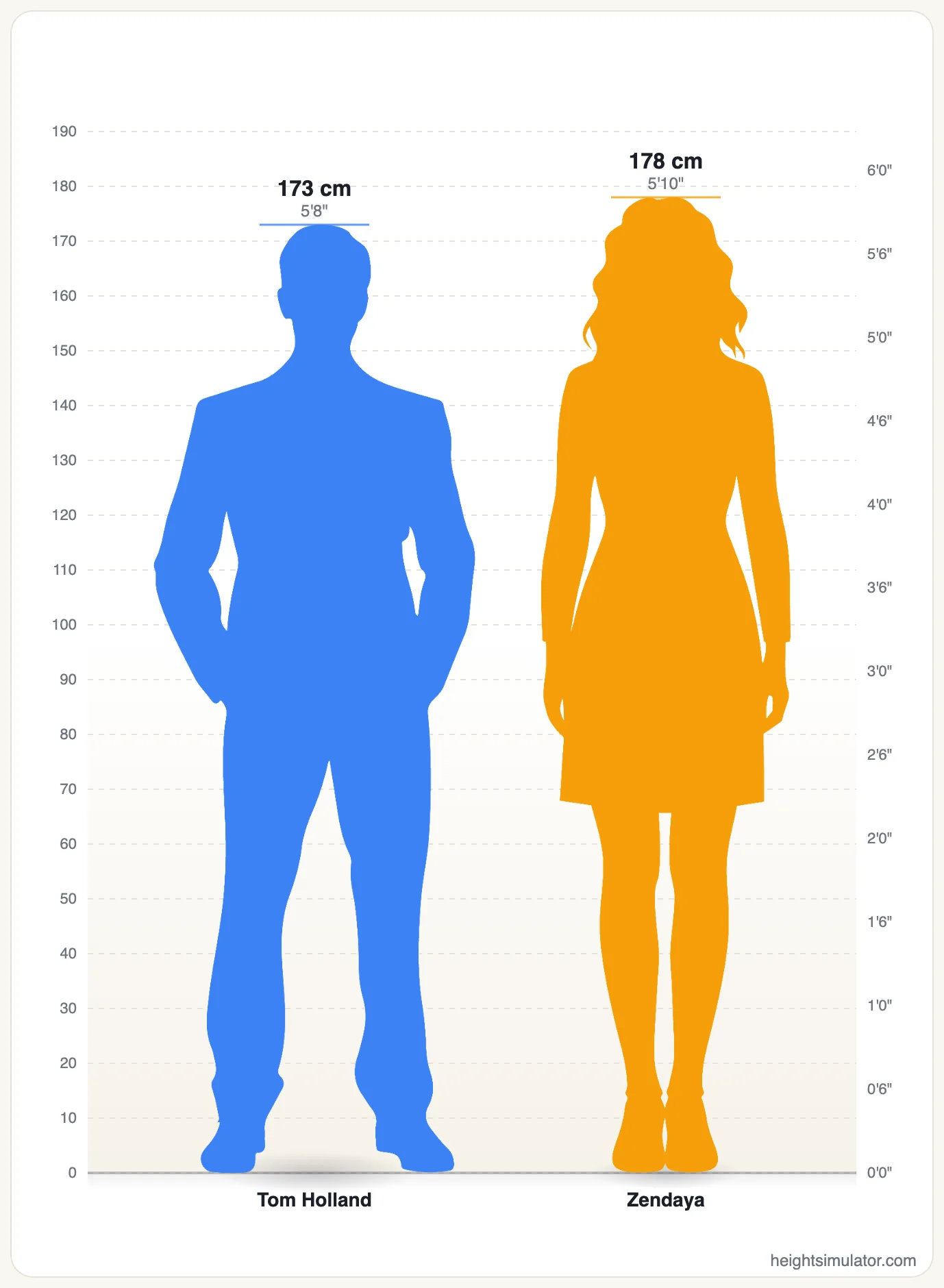
Holland, listed at around 5'8", regularly appears beside Zendaya, listed at around 5'10", often in heels that extend the difference further. He neither hunches nor tiptoes. He stands at full height in trim, well-proportioned suits, usually tonal, with jackets cut to the hip and trousers hemmed clean to the shoe, and treats the height difference as a non-event. Observers follow his lead; a difference nobody on the carpet is managing stops being the story.


Bruno Mars on a crowded stage
Mars is listed at around 5'5" and routinely performs beside taller bandmates, yet he reads as the biggest figure on the stage. His stack is textbook: a pompadour that adds visible inches to the top line, Cuban-heeled boots, high-waisted trousers that stretch his leg line, and matching or monochrome stage outfits that turn his frame into one unbroken column. Seen from the audience, the proportions say tall, and proportions are all the audience can see.
Prince, the original case study
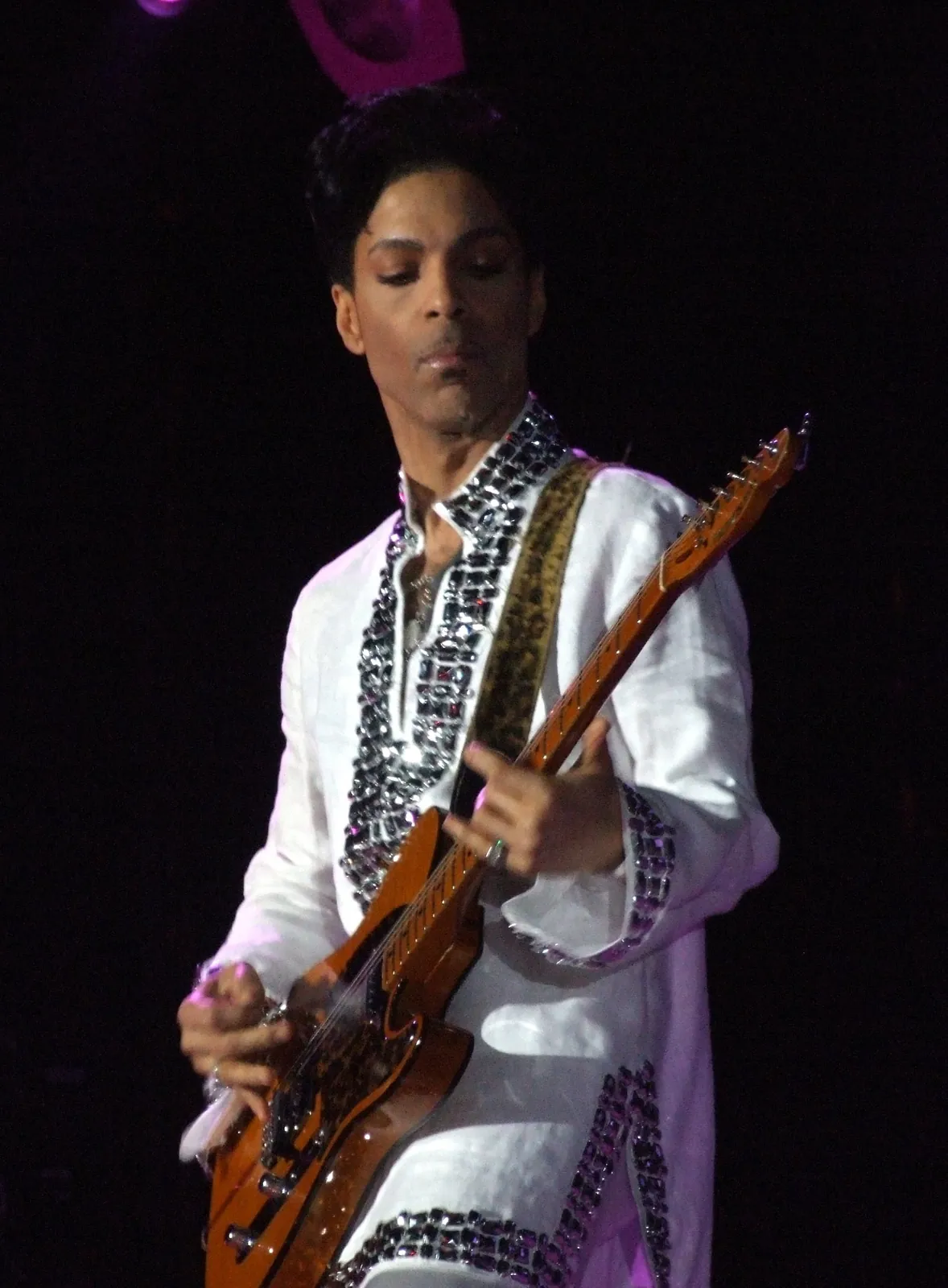
Prince was listed at around 5'2" and commanded arenas next to much taller musicians for four decades. Heeled boots, head-to-toe single-color outfits, high waists, and vertical styling details ran through nearly every look he wore. Few performers have ever demonstrated more completely that the felt size of a man is a composition, not a measurement.

Across all five, notice what you never see: baggy clothing, a contrast belt cutting the frame in half, slouched shoulders, or visible discomfort beside a taller person. The playbook is identical to the one in this guide; they simply run it with professional consistency.
Putting It Together: The Three-Inch Stack
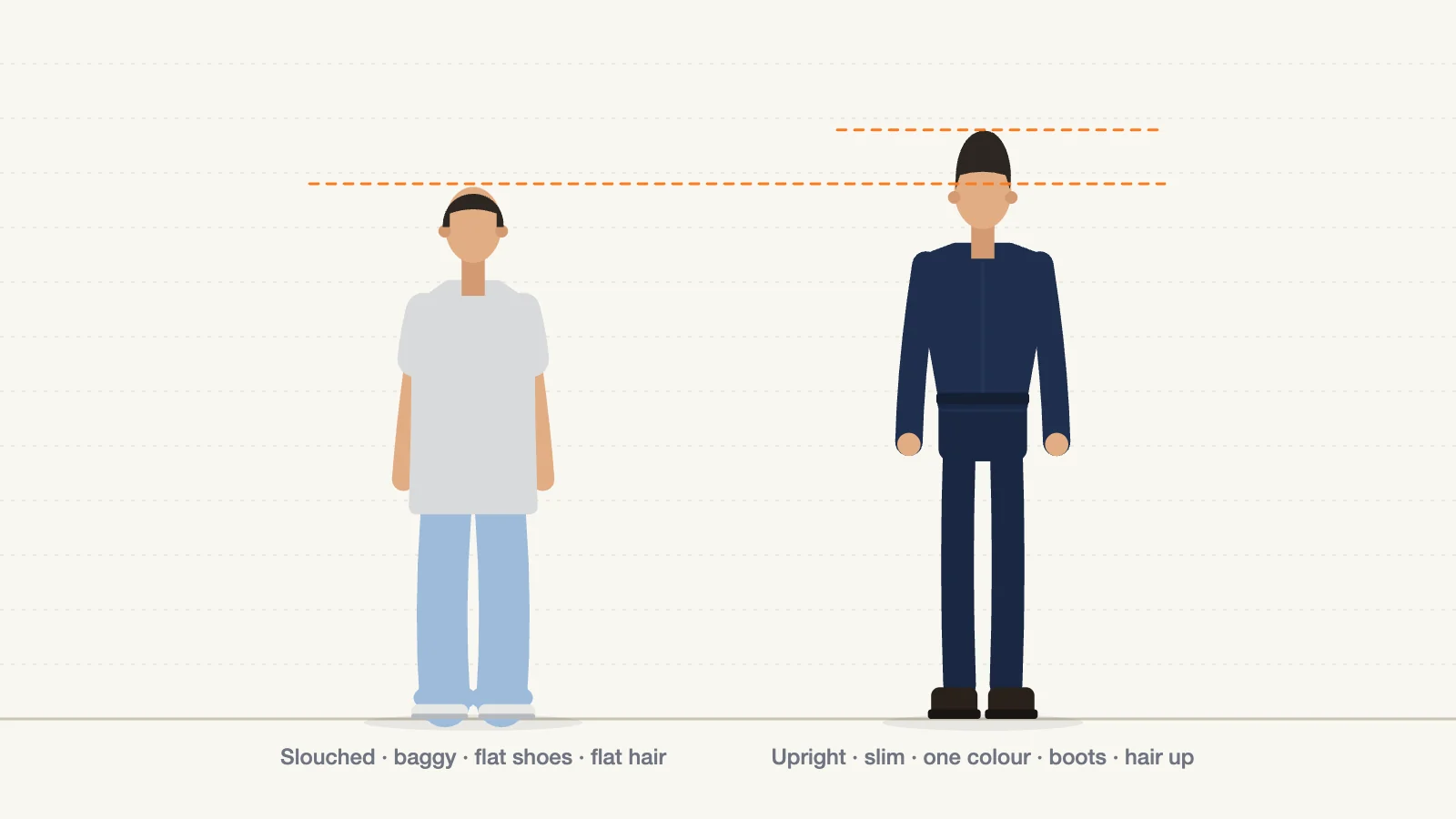
Here is how the levers add up against the baseline most men actually present: slightly slouched, in flat sneakers, low-rise jeans, a long untucked tee, and flat hair.
| Lever | Typical effect | Measured or perceived |
|---|---|---|
| Corrected posture | Around 0.5 to 1 inch restored | Measured; shows on a tape |
| Boots or substantial soles (vs. flats) | Around 0.5 to 1 inch net gain | Measured while worn |
| Discreet in-shoe lift (optional) | Around 0.5 to 1 inch | Measured while worn |
| Hair styled for height | Around 0.5 to 1 inch of top line | Perceived; part of your silhouette |
| Fit, color column, raised waistline | Shifts height estimates upward | Perceived; multiplies the rest |
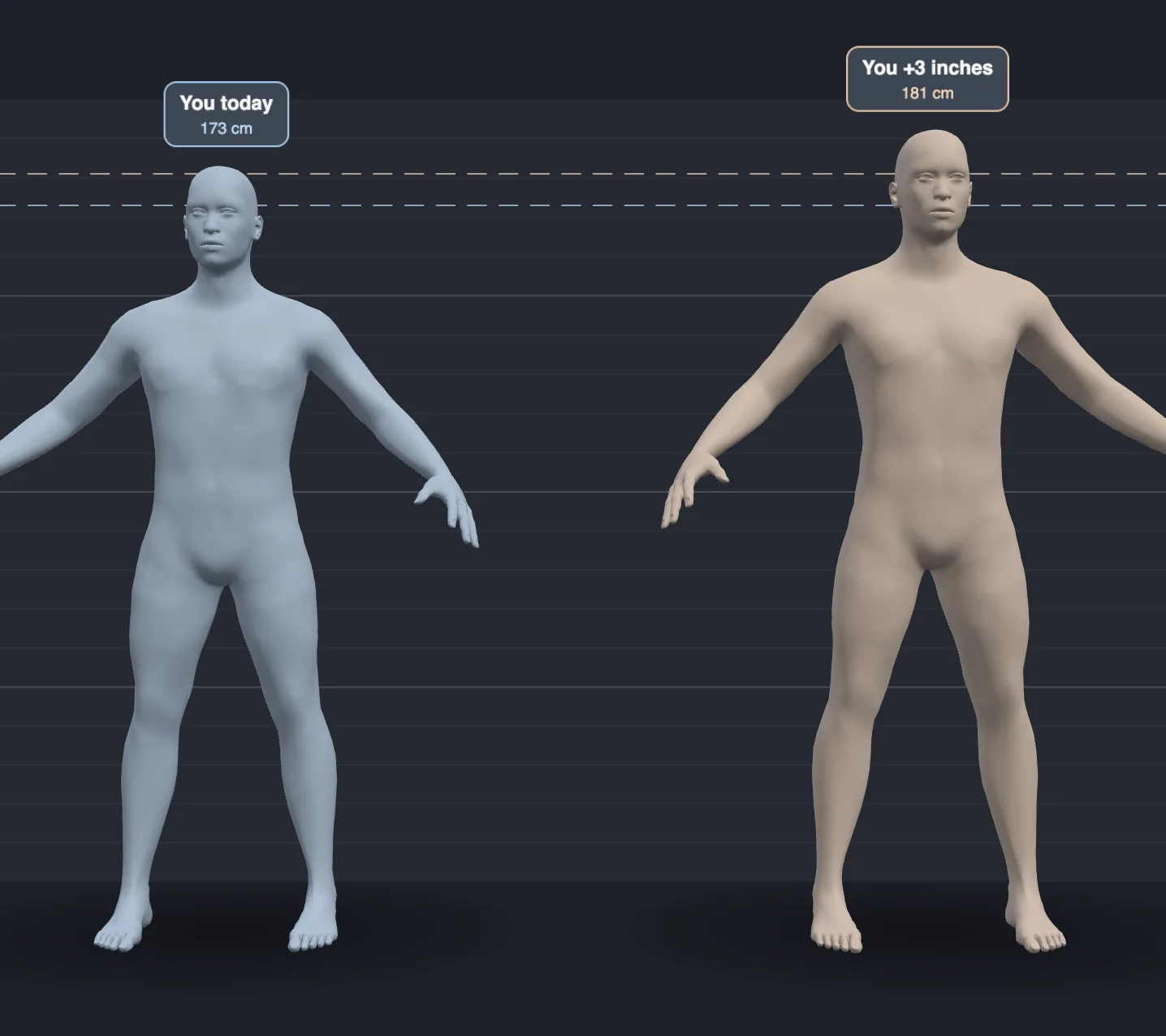
The measured items alone reach roughly one and a half to three inches over that baseline, and the perceptual items are what stop the result from reading as a shorter man in tall shoes: they make the whole figure agree with the new number. To see the end state before you invest in any of it, build yourself twice in the 3D height comparison, once at your current height and once three inches up, and stand the two figures side by side.
A short word on what this guide deliberately leaves out: supplements, "height growth" programs, and stretching systems that promise permanent gains for adults. Adult long bones have finished growing once their growth plates close, and no product changes that. Everything above works precisely because it makes no such claim; it recovers height you already have and manages the judgment of it.
Conclusion
Looking three inches taller is not one trick, and it is certainly not just a shoe. It is a stack of small, compounding signals, real centimeters from posture, footwear, and hair, multiplied by a slim outline, one unbroken color column, and a raised visual waistline, and the men who are famous for pulling it off pull every lever at once, consistently. Start with the free one tonight by fixing how you stand, add the levers that cost a haircut and a hem, and check your progress the honest way: put the before and after versions of yourself side by side in the height simulator and see how much of the three inches is already yours.